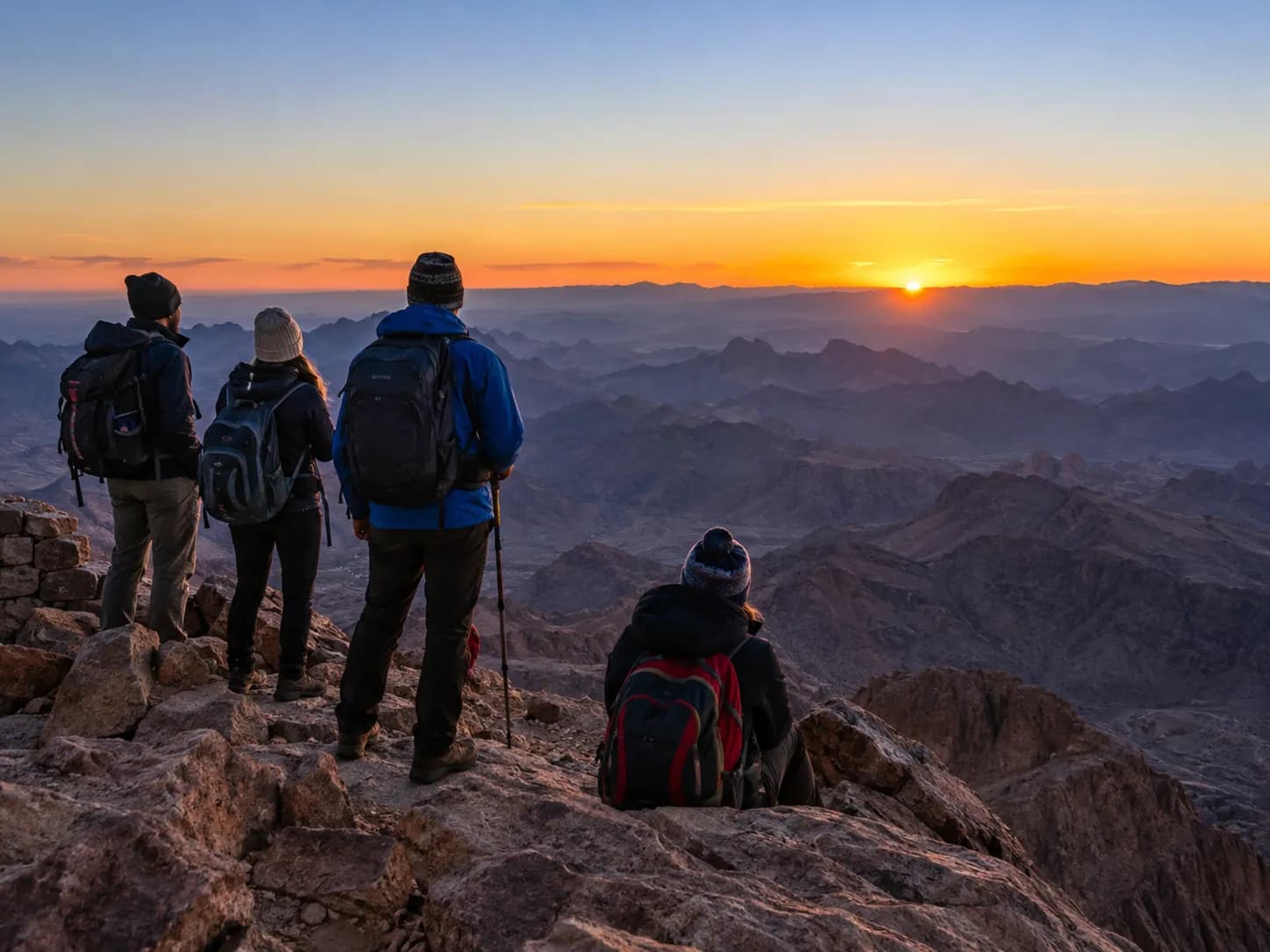
The Sinai desert covers the triangular peninsula between the Gulf of Suez and the Gulf of Aqaba, where Africa meets Asia. In the south it is a land of red granite mountains: climb Mount Sinai (2,285 m) at night for sunrise, visit St Katherine’s Monastery, walk the Coloured Canyon and sleep at a Bedouin camp. Spring and autumn are the best seasons.
Sinai is the only part of Egypt that lies in Asia. Its south is a high, dry massif of red and grey granite cut by deep wadis, with the clear water of the Red Sea on both sides — mountains and sea within an hour of each other.
Where is the Sinai desert?
The Sinai Peninsula lies east of the Suez Canal, bounded by the Gulf of Suez to the west and the Gulf of Aqaba to the east. The southern part, where the mountains and the resorts are, is reached through Sharm El Sheikh airport or by road from Cairo. Dahab and Nuweiba sit on the Gulf of Aqaba; the town of St Katherine lies in the high mountains in the middle.
Our Sinai trips stay in South Sinai — Sharm El Sheikh, Dahab, Nuweiba and St Katherine. Many governments advise against travel to North Sinai; check your own government’s advice before you go.
Mount Sinai and St Katherine
Mount Sinai, Jebel Musa in Arabic, rises to 2,285 m above the town of St Katherine. Most people climb at night to reach the summit for sunrise. The usual route follows the wide camel path for about two and a half to three hours, then the last 750 steps to the top; camels can carry you most of the way up the path. The other way down is the Steps of Repentance, a steep stone stair of more than 3,000 steps.
At the foot of the mountain stands St Katherine’s Monastery, founded in the 6th century and one of the oldest working Christian monasteries in the world. The area is a UNESCO World Heritage Site. The monastery opens to visitors only for limited hours, usually in the morning, so plan the climb to finish in time.
It is cold at the summit before dawn in every season, and freezing in winter. Bring a warm jacket, a hat and a head torch.
Canyons and Bedouin camps
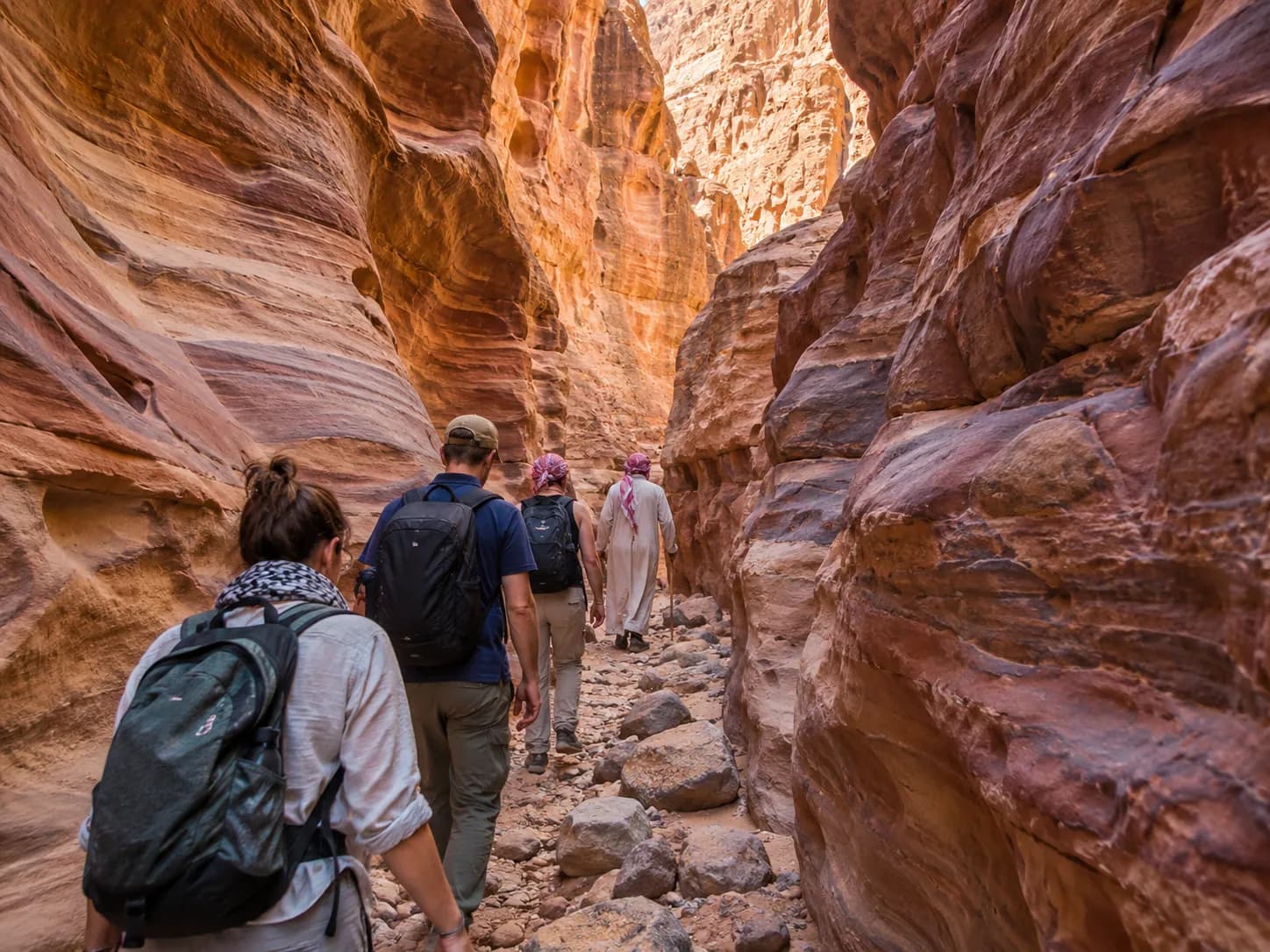
The Coloured Canyon near Nuweiba is a narrow slot canyon whose walls are banded in red, yellow and purple; the walk through it takes an hour or two and includes some easy scrambling. In the mountains above Dahab, Bedouin families host visitors at simple camps: dinner cooked in the sand, tea, and a sky full of stars far from any town.
When to go
March to May and September to November are the best months for walking: warm days and cool nights. Summer days are hot in the valleys, though the high mountains stay cooler. Winter brings cold nights and occasionally snow on the peaks around St Katherine.
Questions people ask
On the Sinai Peninsula, east of the Suez Canal between the Gulf of Suez and the Gulf of Aqaba. It is the part of Egypt that lies in Asia.
About two and a half to three hours up by the camel path and the final 750 steps, and around two hours down.
It is a long walk rather than a technical climb. The last steps are steep; camels can take you most of the way up the path.
Spring (March to May) and autumn (September to November), when days are warm and nights are cool.
South Sinai’s resorts, St Katherine and the main desert routes are visited by many travellers. Travel with a licensed operator and check your government’s current advice, which usually covers North Sinai separately.