

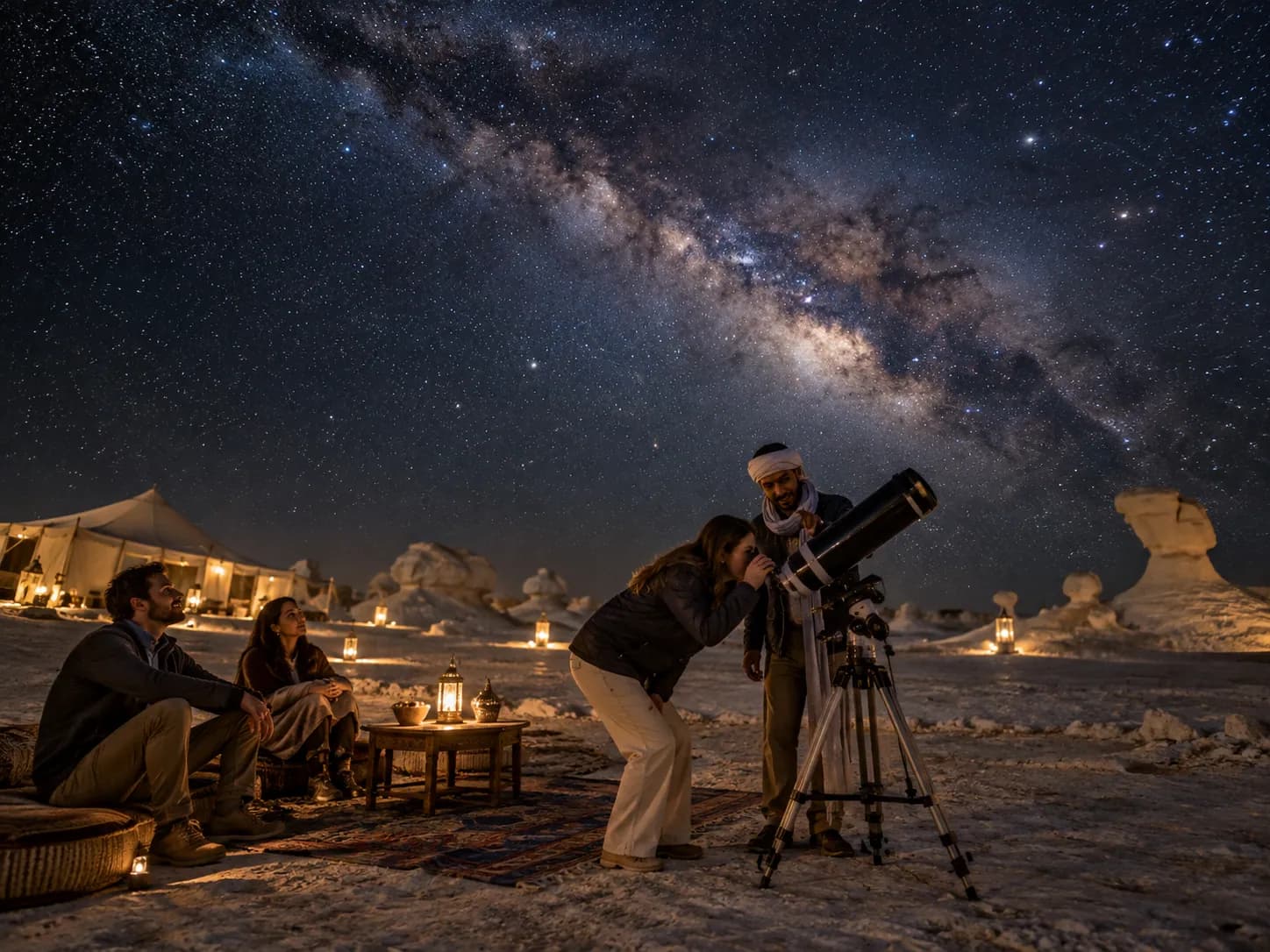
Egypt’s deserts are home to the fennec fox, the smallest fox in the world with huge ears, and to Rüppell’s fox; both are shy and active at night, and they often visit White Desert camps after dark. You may also see dorcas gazelles, jerboas and, in the mountains, Nubian ibex. Please don’t feed the foxes.
It usually happens after dinner. Someone points a torch at the edge of the firelight, and there it is: a small, sand-coloured fox with enormous ears, watching the camp from a safe distance.
The desert foxes
The fennec fox is the smallest fox in the world, about the size of a small cat, with ears that can reach around 15 cm. The ears release heat and pick up the sound of insects and small animals under the sand. Fennecs live in burrows in sandy desert, rest through the heat of the day and hunt at night.
Rüppell’s fox, or the sand fox, is a little larger and longer-legged, with a white tip to its tail. It is also nocturnal and lives in the Western Desert and Sinai.
In the White Desert, foxes have learned that camps mean scraps, so they come close after dark. You will see their small footprints around the rocks the next morning.

Other animals you may see
Dorcas gazelles: small, pale gazelles of the open desert, most often seen in protected areas such as Wadi El Gemal near Marsa Alam.
Jerboas: tiny desert rodents that hop on long hind legs, mostly seen at night in the headlights.
Nubian ibex: wild goats with great curved horns, living on the cliffs of the Sinai and Red Sea mountains.
Birds: migrating birds rest in the oases and at the Fayoum lakes in spring and autumn, and flamingos winter on Lake Qarun.
Scorpions and snakes live in the desert too but keep out of sight, especially in the cool months. Shake out your shoes in the morning and use a torch at night, and you are very unlikely to meet one.
Seeing them without harming them
Please don’t feed the foxes: human food makes them sick and teaches them to depend on camps. Keep torches low and red if you can, stay quiet, and let them come to you. Take your rubbish home with you.
The other “Desert Fox”
If you were searching for the “Desert Fox” of history: that was the nickname of the German field marshal Erwin Rommel, who commanded the Axis forces in North Africa in the Second World War. The decisive battles of El Alamein in 1942 were fought on Egypt’s Mediterranean coast, on the road you take to Siwa; the war cemeteries and the military museum at El Alamein are an easy stop on the way.
Questions people ask
Yes. Fennec foxes live in the sandy deserts of Egypt, including the Western Desert, and are often seen around White Desert camps at night.
The most reliable place is a night at camp in the White Desert, where foxes come close after dark.
No. They are small, shy animals. Don’t feed or touch them, and keep food stored at night.
Erwin Rommel, the German commander in North Africa in the Second World War, was known as the Desert Fox. The battles of El Alamein were fought on Egypt’s north coast in 1942.