

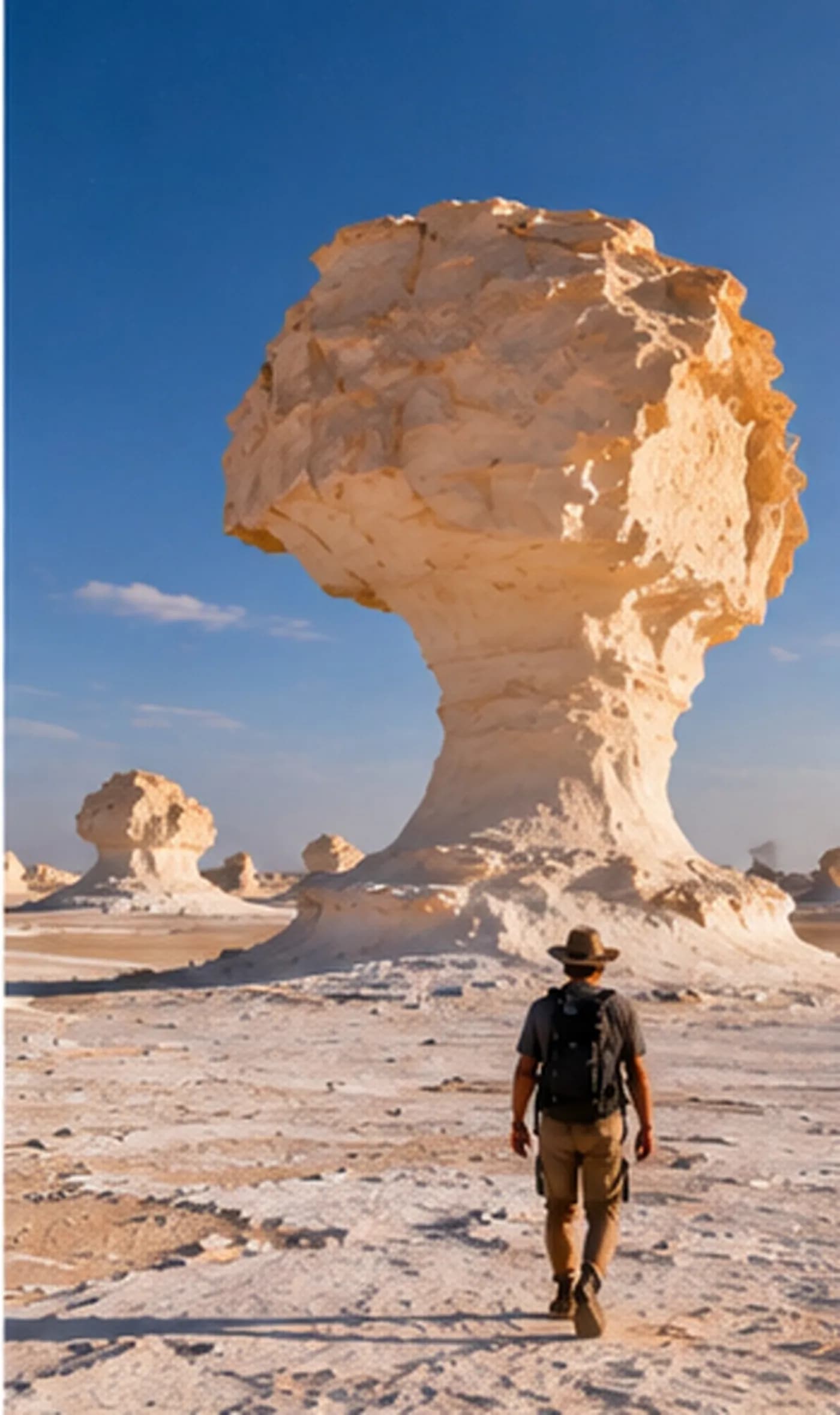
The White Desert is a national park of white chalk formations about 500 km south-west of Cairo, near the Farafra oasis. Most visits are two or three days and include a night camping among the rocks. Days from October to April are 21–31 °C, but nights are cold: around 5–6 °C on average in December and January, and close to freezing on the coldest nights.
At first it looks like snow. Then the shapes come into focus: mushrooms, towers, a chicken, a sphinx, all carved by the wind out of soft white chalk and standing on a floor of sand. The White Desert is the most famous landscape of Egypt’s Western Desert, and one of the best places in the country to spend a night outside.
Where is the White Desert?
The White Desert (Sahara el Beyda in Arabic) lies about 500 km south-west of Cairo, between the Bahariya and Farafra oases. It has been a protected area since 2002. The road from Cairo reaches Bahariya after about 370 km, and the chalk formations begin roughly an hour and a half further south.
What you see on the way
Bahariya oasis: palm gardens and hot springs, where most trips stop on the way out.
The Black Desert: hills of orange sand capped with dark volcanic stone, as if someone had sprinkled them with coal. A short climb gives a view across the whole valley.
Crystal Mountain: a small ridge of quartz crystals right beside the road.
Agabat: a valley of tall dunes between limestone cliffs, usually the off-road section of the route, just before the chalk begins.
How cold is the White Desert at night?
Colder than most people expect. With no cloud and no humidity, the heat of the day escapes quickly after sunset. Typical temperatures, from day to night:
From November to February, pack a down jacket or thick fleece, a warm hat and socks to sleep in. We bring thick sleeping bags, mattresses and blankets.
A night at camp
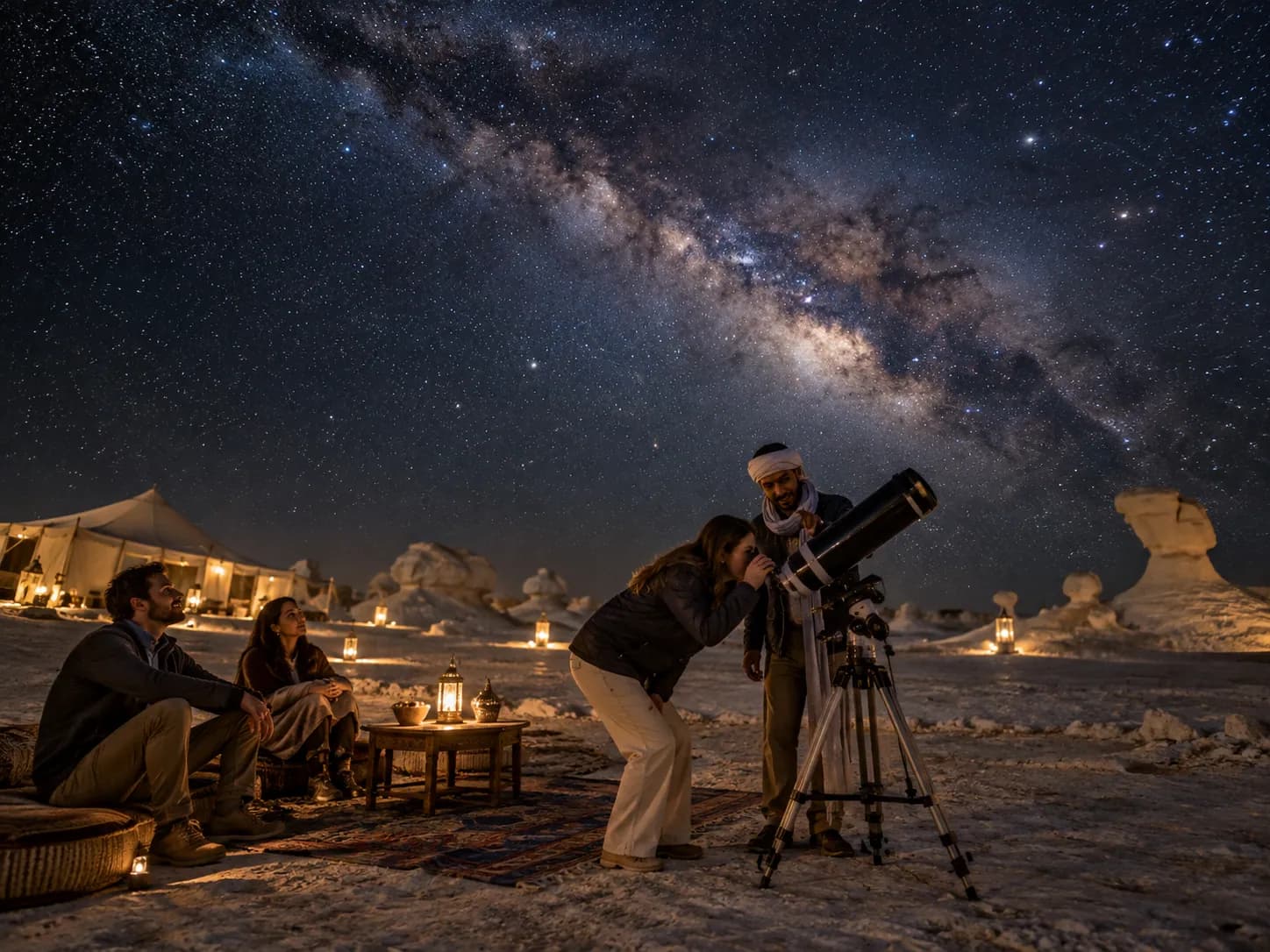
Camp is set up in the shelter of the rocks in the late afternoon: a windbreak, mattresses and a fire. Dinner is cooked over the coals. After the fire burns down, the sky takes over — there is almost no light for hundreds of kilometres, and on nights near the new moon the Milky Way is clearly visible. Small desert foxes often come to the edge of camp after dark.
Questions people ask
From December to February nights average around 5–6 °C and can approach freezing. In October, November and March they are milder, around 9–15 °C.
About 500 km by road, or five to six hours’ driving, via the Bahariya oasis.
Not comfortably. It is about 500 km each way, so two days with a night at camp is the minimum.
Yes. It has been a protected area since 2002, and a park fee is paid on entry.
The White Desert is a plain of white chalk formations; the Black Desert, about 80 km to the north, is a landscape of hills capped with dark volcanic stone. Most trips visit both.